老派自然语言处理之必要
Context-free Grammar
Basic Concepts
S: start symbol
T: non-terminals
x,y,1,2,3….: terminals
$\epsilon$ empty string
Derivations: A sequence of
steps where non-terminals are
replaced by the right-hand side
of a production rule in the CFG.
CFL L(G)
Every regular language is context-free.
Regex Examples:
b* : X-> $\epsilon$ | Xb
[cde] : Y-> c | d | e
S -> aSb | $\epsilon$ cannot be expressed by regex, because regex cannot express a string with a string with same amount of a and b.
L0
CFG covers more than we really want, but it is already useful for parsing.
eg. VP -> Verb NP “write a flight” do not make sense.
Non-CFL Example
$L={a^nb^nc^n|n>0}$
CNF (Chomsky normal form)
Definition: A CFG is CNF if it is $\epsilon$-free.
Explanation: Either A -> BC or A->a
Theorem: Any CFG can be converted into CNF. (eg.b*)
Parsing
Definition: syntatic parsing means mapping from a scentence to its parse tree.
CKY Parsing
First, convert grammar to CNF.
Then, dynamic programming.
1 | |
| Non-terminal | Production Rules | |
|---|---|---|
| S | $\to$ NP VP | |
| NP | $\to$ Det Nom \ | PropN |
| Nom | $\to$ Noun \ | Noun Nom |
| VP | $\to$ Verb NP \ | Verb |
| Det | $\to$ ‘the’ \ | ‘a’ |
| Noun | $\to$ ‘book’ \ | ‘flight’ |
| PropN | $\to$ ‘Houston’ | |
| Verb | $\to$ ‘booked’ |
Convert to CNF:
| Non-terminal | Production Rules | ||
|---|---|---|---|
| S | $\to$ NP VP | ||
| NP | $\to$ Det Nom \ | ‘Houston’ | |
| Nom | $\to$ ‘book’ \ | ‘flight’ \ | Noun Nom |
| VP | $\to$ Verb NP \ | ‘booked’ | |
| Det | $\to$ ‘the’ \ | ‘a’ | |
| Noun | $\to$ ‘book’ \ | ‘flight’ | |
| PropN | $\to$ ‘Houston’ | ||
| Verb | $\to$ ‘booked’ |
the book booked
Apply CKY:
(0,1): Det
(1,2): Nom/Noun
(0,2): (0,1)+(1,2) NP -> Det Nom
(2,3): VP/Verb
(1,3): (1,2)+(2,3) 空
(0,3): (0,2)+(2,3) S -> NP VP
Latent Semantic Analysis
TD Matrix
document number |D|
vocab number |V|
|V|$\times$ |D|
每一个entry代表这个词在文件里出现的次数
Good: related words do appear together!
Bad: Related words “sometimes” appear together, the co-occurrence statistics might be sparse(矩阵中0很多)
SVD
- 目标: 不直接使用高维、稀疏的词-文档矩阵 ($W_{td}$),而是为每个词汇 ($w$) 和文档 ($d$) 推断出一个低维的潜在向量 (Latent Vector, lv) 表示。
- 数学近似: 词 $i$ 与文档 $j$ 的关系 $W_{td}(i, j)$ 被近似为它们潜在向量的点积(并确保非负):
- $W_{td}$ 矩阵: 行是词汇,列是文档,单元格是词频或TF-IDF值。
| 矩阵 | 作用 | 描述 |
|---|---|---|
| $U$ | 词表示矩阵 | 包含词汇的潜在向量表示(行)。 |
| $\Sigma$ | 奇异值矩阵 | 对角矩阵,包含奇异值,用于确定降维时保留多少维度(即潜在语义的数量)。 |
| $V^T$ | 文档表示矩阵 | 包含文档的潜在向量表示(列)。 |
保留最重要的k个奇异值——保留U的前K列,V的前K行
- 问题: SVD 产生的 $U$ 和 $V$ 矩阵是正交的,并且其元素可以包含负值。这与原始的 $W_{td}$ 矩阵是非负的特性不符,有时会降低模型结果的可解释性。SVD would pay too much attention to the high-freq words!
TF-IDF normalization
Smoothed版本,用于避免除以零和给予常见词语非零的得分:
逆文档频率 $\text{idf}(i)$ 衡量一个词 $i$ 在整个语料库中的普遍性或稀有性。它的核心思想是:一个词在越少的文档中出现,它就越具有区分度,其权重就应该越高。
EM Algorithm
GMM
mixture of gaussian distributions
隐变量 $z$(Latent Assignment)
- 定义: $z$ 是一个离散的隐变量,代表观测到的数据点 $x$ 是由哪个高斯分量 $c$ 生成的。
- 特点: 我们观察到数据 $x$,但不知道 $x$ 属于哪一个分量(即 $z$ 是隐藏的)。
生成一个数据点 $x$
选择混合分量:
- 首先,以概率 $\pi_c$ 选择一个高斯分量 $c$。$\pi_c$ 就是该分量的混合系数。
从分量中采样:
- 一旦选择了分量 $c$,就从这个分量对应的高斯分布 $\mathcal{N}$ 中采样生成数据点 $x$。
求和
由于隐变量 $z$ 是我们不知道的,为了得到观测数据 $x$ 的总概率 $p(x)$,我们需要对 $z$ 的所有可能取值(即所有的分量 $c$)进行求和(边缘化):
EM algo
GOAL: find $\theta$ to maximize log likehood of observed data.
1. 随机初始化 (Random Initialization)
随机设定模型的初始参数 $\theta_0$。例如,在 GMM 中,就是随机设置每个高斯分量的初始 $(\pi_c, \mu_c, \sigma_c)$。
- 注意: E-M 算法保证收敛到局部最优解,因此初始化的选择会影响最终的结果。
2. 迭代直到收敛 (Iterate until convergence)
不断重复 E 步和 M 步
E 步 (Expectation Step): 猜测隐变量($Z$)的隶属关系
- 公式: 计算 $q(Z) := p(Z|X, \theta_k)$。
$X$ 是观测数据,假设 $\theta_k$是对的,得到关于$Z$ 的最佳猜测分布 $q(Z)$
具体表现为每个数据点 $x_i$ 来自每个分量 $c$ 的概率:
$$\gamma_{ic} = p(z_i = c | x_i, \theta_k)$$
 $\gamma_{ic}$(Responsibility)
M 步 (Maximization Step): 精修模型参数($\theta$)
假设现在$q(Z)$是真实的, 更新 $\theta$ 以最大化
关键: 经过 E 步的转换,这个期望函数的形式通常简化为具有解析解(Closed-Form Solution),允许我们直接计算出最优的 $\theta$。
Hidden Markov Model (HMM)
Motivation task: position tagging, named entinity recognition.
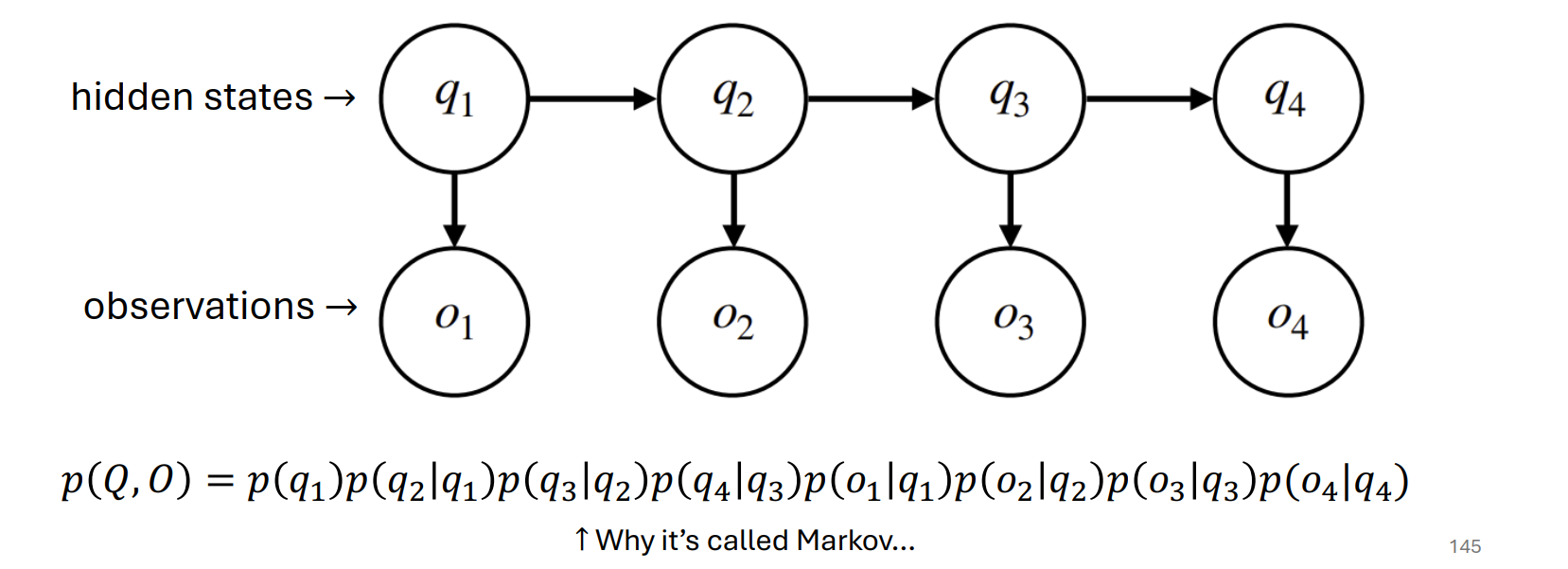
inital probability: $\pi$
hidden states transfer:
$p(q2 \mid q_1) = a{q_1, q_2}$
emission probability: $b_i(o_k)$
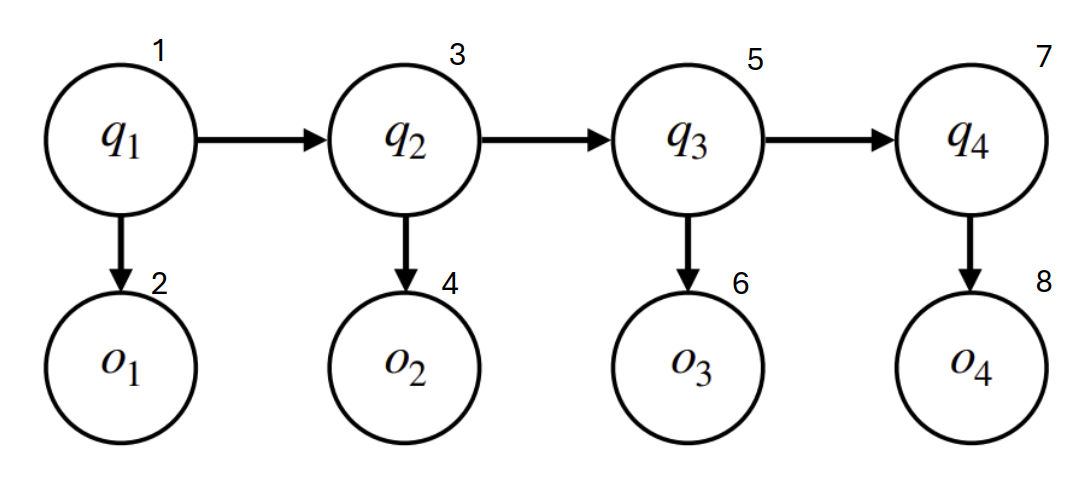
topology order: 先生成o在生成下一个q
marginal probability of an observation: $p(\mathbf{O})=\sum_{\mathbf{Q}} p(\mathbf{O}, \mathbf{Q})$.
N: number of hidden state Q
T:sequence length
路径总数 $(num tags)^{seqlen}=N^T$
每条路径计算成本 $O(T)$
总成本$O(TN^T)$
forward algorithm
j一共有N个,算到T步需要算T次,一次N复杂度,所以是$O(N^2T)$
backward algorithm
Vertibi——find the most probable q
因为P(O)是观测到的常数
表示在观测到序列的前 $t$ 个元素 $(\mathbf{O}_{1:t})$ 的条件下,所有以隐藏状态 $q_t = j$ 结尾的路径中,最大概率的那条路径的概率值:
Where do $\pi$ A ,B come from
Supervised learning: labeled data.
Unsupervised learning:
DGM(Direct Graphical Model)
normalized property
For DAG, as long as each of the (separate) conditional distribution is a valid (normalized), then the joint distribution is normalized.
(这里 $O$=overweight, $S$=smoking, $H$=heart disease, $C$=cough)
我们对所有变量求和:
对 $C$ 求和: 因为 $P(C \mid S)$ 是归一化的,所以 $\sum_{C} P(C \mid S) = 1$。
对 $H$ 求和: 因为 $P(H \mid O, S)$ 是归一化的,所以 $\sum_{H} P(H \mid O, S) = 1$。
对 $O$ 和 $S$ 求和: 因为 $P(O)$ 和 $P(S)$ 是独立的边缘分布,我们可以分别求和:
由于边缘分布本身是归一化的:$\sum{O} P(O) = 1$ 且 $\sum{S} P(S) = 1$。
acyclic
A<->B
If I “set” P(A=0|B=0)=1, P(A=1|B=1)=1, P(B=1|A=0)=1, P(B=0|A=1)=1…
Basically B is 100% sure that A=B, while A is 100% sure that A!=B…
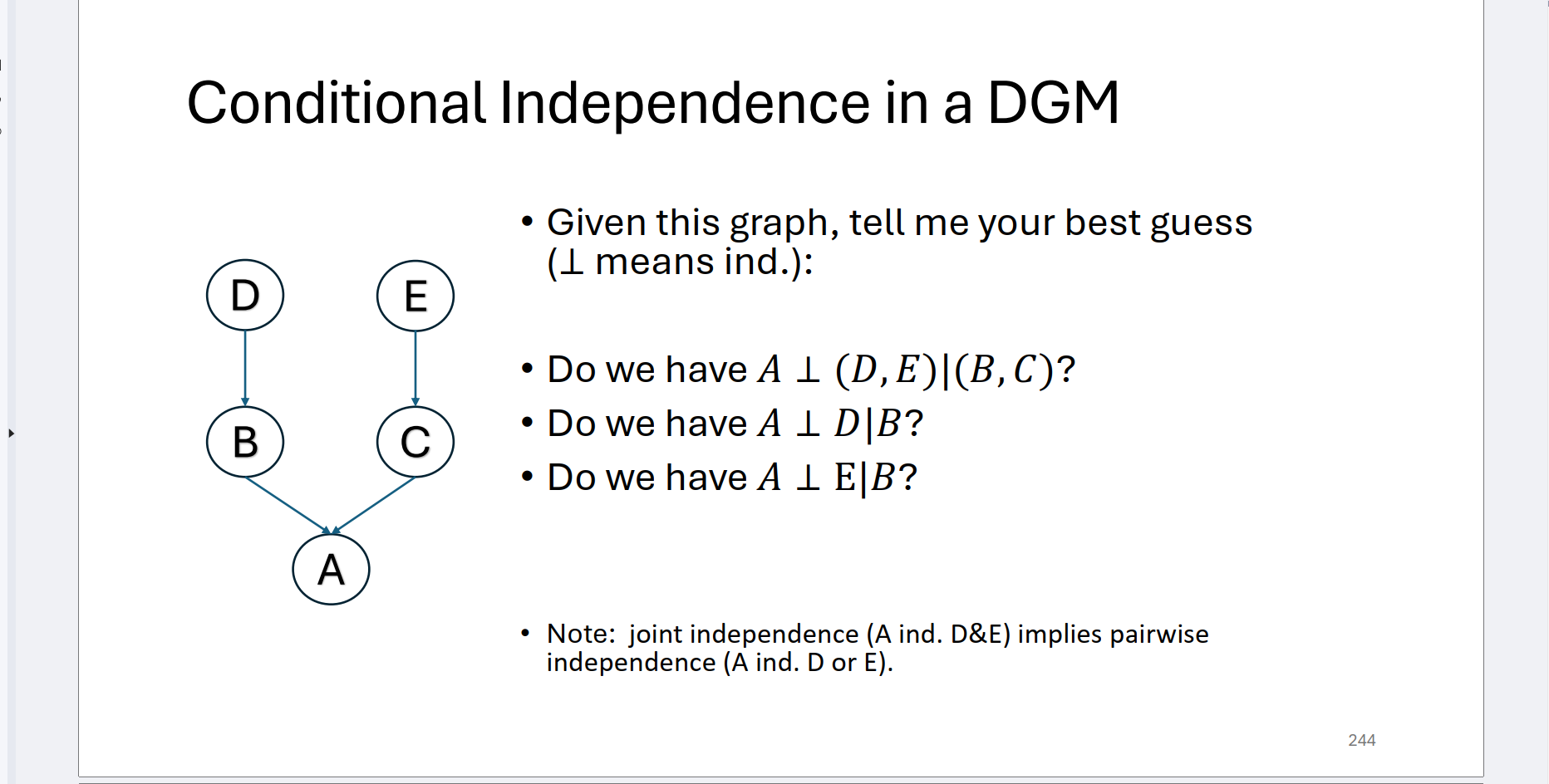
第一个的意思是:在已知 $B$ 和 $C$ 的条件下,$A$ 是否独立于 $D$ 和 $E$ 的联合集合?
答案:是是否
汇聚节点
A->B<-C 观测到B,AC不独立
D-连接 (d-connected) 的定义
(1) 汇聚节点条件 (Collider Rule): 路径 $U$ 上的每一个汇聚节点(Collider,即 $\rightarrow Z \leftarrow$ 结构中的 $Z$)都有后代位于观测集 $W$ 中**(包括 $Z$ 本身位于 $W$ 中)。
* **含义:** 汇聚节点上的信息流必须被观测到(或者其结果被观测到)才能被**打开**。
(2) 非汇聚节点条件 (Non-Collider Rule): 路径 $U$ 上的其他任何节点(非汇聚节点,即串联 $\rightarrow Z \rightarrow$ 或发散 $\leftarrow Z \rightarrow$ 结构中的 $Z$)都不在观测集 $W$ 中。
N-gram LM
Various applications of LM
Generation
• Auto-complete
• Speech-to-text
• Question-answering / chatbots
• Machine translation
• Summarization
Classification
• Authorship attribution
• Detecting spam vs not spam
• Grammar Correction
N-gram
Unigram LM
认为每一个词都是独立的,容易导致错误的句子和正确的句子概率一样
Bigram LM 每两个词来考虑
Ngram LM
真实的概率
N-gram 模型假设一个词 $wt$ 的出现只依赖于它前面紧邻的 $N-1$ 个词,而不是全部的历史 $w{1:t-1}$。
special tokens
\
\
set word appear at least twice as vocabulary and others as \
How to get P?
MLE:
Problem: Sparsity, if we study NLP does not apper in the training corpus, then the probability will be 0.
add-k smoothing
因为 Add-k 对所有 N-gram 都一视同仁地增加了 $k$,这可能会对高频 N-gram 的概率造成不必要的扭曲
Interpolation or backoff
线性插值公式: 将不同阶的 N-gram 模型的概率进行加权平均:
$$P_{tri}(w_t | w_{t-2}w_{t-1}) = \lambda_1 P_{tri}(w_t | w_{t-2}w_{t-1}) + \lambda_2 P_{bi}(w_t | w_{t-1}) + \lambda_3 P_{uni}(w_t)$$
回退: 如果 Trigram 计数为 0,则回退到 Bigram 模型 $P_{bi}$。
$$P_{tri-BO}(w_t | w_{t-2}w_{t-1}) = \begin{cases} P^*_{tri}(w_t | w_{t-2}w_{t-1}) & \text{if } count(w_{t-2}w_{t-1}w_t) > 0 \\ \alpha(w_{t-2}w_{t-1})P_{bi}(w_t | w_{t-1}) & \text{otherwise} \end{cases}$$
LM evaluation
PPL(Perplexity) 越低越好
- $P(W)$ 是模型计算出的整个测试集句子的概率。
- $token_len(W)$ 是测试集中的词/token总数。
PPL does not involve actual generation. (衡量模型分配给已知测试数据的概率高低)
PPL cares more diversity than quality.
Example: If LM’s probability concentrate on a small set of very good
sentences, then the model’s PPL on a held-out set will be very bad.
Word2Vec
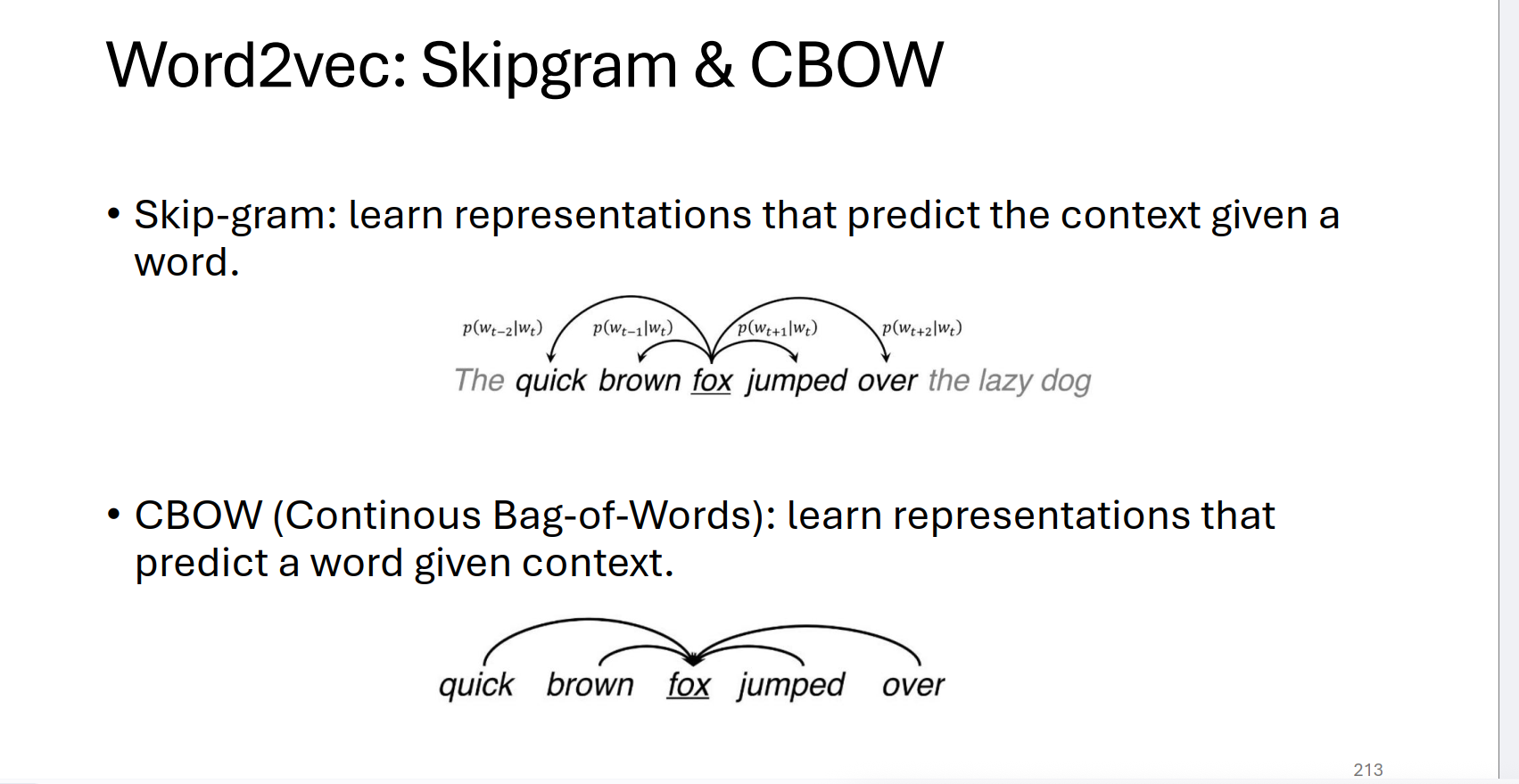
parameters: input embedding W for context, output embedding U for prediction.
every row is a vector for a word.
Skipgram
objective:
computation bottleneck: 分母takes $O(V)$ to compute.
solution:negative sampling
- 对于一个给定的中心词 $x$ 和一个上下文词 $y$(这是一个正例),我们希望模型预测它们是一对的概率高。
- 我们随机抽取 $k$ 个负例 $y’$(非上下文词),希望模型预测 $x$ 和这些 $y’$ 不是一对的概率高。
| 符号 | 含义 | 解释 |
|---|---|---|
| $\log \sigma(\mathbf{u}_y \cdot \mathbf{w}_x)$ | 正例项 | 希望最大化 $x$ 和真实上下文 $y$ 是一对的概率(点积越大,$\sigma$ 越大,$\log \sigma$ 越接近 0)。 |
| $\log \sigma(-\mathbf{u}_{y’} \cdot \mathbf{w}_x)$ | 负例项 | 引入负号 $(-\dots)$,目的是希望最大化 $\sigma(-\mathbf{u}{y’} \cdot \mathbf{w}_x)$,这等价于最小化 $\sigma(\mathbf{u}{y’} \cdot \mathbf{w}_x)$。这迫使模型预测 $x$ 和非上下文 $y’$ 不是一对的概率高。 |
| $P_n$ | 负采样分布 | “$\mathbf{P}_n$ can be a unigram model.” 通常使用词汇的一元模型(Unigram Model)作为采样分布,即词 $v$ 被采样的概率与其在语料库中的频率相关。 |
Q1: 在 SGD 训练过程中,所有向量都会收敛到同一个值吗?为什么?
不会收敛到同一个值。
- 目标函数的分母 (Softmax): 分母 $\sum{v \in V} \exp(u_v \cdot w{\text{input}})$ 会计算输入词向量 $w_{\text{input}}$ 与词汇表中所有词的输出向量 $u_v$ 的相似度。这意味着,为了最大化上下文词的概率,模型必须学会在高维空间中将词语区分开来。
- 上下文关系: 不同的词有不同的上下文。例如,“猫”的上下文通常是“抓”、“毛茸茸”,而“车”的上下文通常是“驾驶”、“轮胎”。模型会根据这些不同的统计关系,将具有相似上下文的词汇拉近,将不相似的词汇推远。
Q2: 拥有一个不同的输出嵌入矩阵 $U$ (Output Embedding) 是否有用?
角色分离 (Separation of Roles):
- $W$ (输入嵌入/中心词): 学习如何表示一个词,以便它能被用于预测其上下文。
- $U$ (输出嵌入/上下文词): 学习如何作为一个分类器或预测层的权重,来识别哪些词是中心词的上下文。
CBOW
| 符号 | 含义 | 解释 |
|---|---|---|
| $\mathbf{u}_{x_t}$ | 输出词向量 | 词 $x_t$ 作为输出词时的向量表示。 |
| $\mathbf{w}_{t+j}$ | 输入词向量 | 上下文词 $w_{t+j}$ 作为输入词时的向量表示。 |
| $\frac{1}{2S}\sumj \mathbf{w}{t+j}$ | 上下文平均向量 | 所有上下文词的输入词向量的平均值(对应图中的 PROJECTION/SUM 结果)。 $2S$ 是上下文窗口中的词数。 |
| $Z$ | 归一化项(Softmax分母) | 这是一个归一化因子,也称为 Softmax 分母。它是词汇表中所有词与上下文平均向量点积的指数之和,确保所有预测概率加起来等于 1。 |
$\mathbf{u}_y$: output embedding for correct label
${E}{p{\theta}(v|x)} [\mathbf{u}_v]$: what the model think is correct.
$\frac{\partial (-\log p(y|x))}{\partial \mathbf{w}_x}$ 这就是梯度
properties of word vector
Linear Word Analogies: wapple-wapples $\approx$ wcar-wcars